Of all the attacks leveled against science by the religious faithful, the most insidious are the ones that cast religion and science as comparable approaches to understanding natural the world. In a debate with Christopher Hitchens at Notre Dame this past January conservative author and speaker Dinesh D'Souza showcased a variation of this kind of "we're just two peas in a pod" claim and, in doing so, succeeded in demonstrating a genuine failure to understand how science really works. In the process, he does no great service to religion, either.
In making his case for a faith-based approach to science, D'Souza proposes that the existence of God can be employed as a working hypothesis much like any other. And, as with any provisional hypothesis, he says it should be embraced when it helps account for phenomena which have otherwise resisted explantion. Seeking confirmation of this God of the gaps argument - familiar to us from the Intelligent Design controversy - D'Souza turns to astrophysics for an illustration of how science relies on the same kind of speculative thinking that religion does. Here is the background on the example he finds there to exploit.
 |
| Galaxy cluster ACO 3341, located almost 500 million years away (European Southern Observatory) |
In the 1920s, not long after galaxies outside our own Milky Way were first identified, they were seen to arrange themselves into clusters, orbiting about one another, presumably, under the influence of their mutual gravitational attraction. Indeed, the working of gravity in these far, far away places was not unexpected. Contrary to popular conception, Isaac Newton's stroke of genius had not been in observing a falling apple - he was hardly the first to notice that things fall - but in his bold conjecture that the force responsible for causing his proverbial knock on the head was the very same force responsible for the motion of the planets about the Sun. Newton's theory proposed that gravity was universal, applying uniformly to everything, everywhere; to the objects of our everyday experience; to the planets and moons of our solar system; and, presumably, to galaxies, each consisting of hundreds of billions of stars, located millions of light-years away.
What took astronomers of the 1930s by surprise was that, when the amount of stuff in these galactic clusters was finally tallied, gravitational accounts did not balance. A census of the visible matter contained within them - stars and dust clouds and other such "luminous" things - resulted in a total mass insufficient to bind them in their mutual orbits. According to calculations the galaxies in these clusters should be flying apart at breakneck speed. The physicists faced a quandary: either Newton had got it wrong, and the force of gravity he proposed was, in fact, not universal, or their exhaustive attempts to catalog the constituents of these galactic clusters had left a significant amount of matter unaccounted for.
 |
| Bullet Cluster, best evidence to date for the existence of dark matter. |
 |
| Next generation detector, Xenon Dark Matter Project |
Now, according to D'Souza, in the same way that physicists have proposed the existence of dark matter as an explanation for an enigmatic phenomenon, the stability of galactic clusters in spite of an apparent insufficiency of mass, so too can we rely on the hypothesis of God to explain other mysteries of the physical world. He contends that such "presuppositions" are valid elements in the construction of scientific theories because they yield immense explanatory payoff; disconnected pieces of a puzzle fall into place and suddenly everything makes sense.
Is D'Souza right? Are "materialist" scientists and those who defer to faith-based hypotheses playing by the same rules? To see how the their approaches differ, consider this observation from a recent physics arXiv blog post - First Evidence That Mirror Matter May Fill the Universe? - regarding ongoing efforts to solve this problem.
Astronomers call this hidden mass 'dark matter' and physicists around the world are engaged in an increasingly desperate race to find evidence of it here on Earth. [emphasis added]Now imagine, for a moment, an analogous report on the state of current investigations into some phenomenon or other "explained" by D'Souza's God presupposition:
Scientists call this hidden cause 'God' and researchers around the world are engaged in an increasingly desperate race to confirm His existence.This comparison, of course, strikes us as ridiculous on its face; no one has ever embarked upon a search for God in order to confirm or refute a physical theory. Good Lord, how could such a search even be conducted? Perhaps more significantly, no teams of researchers have ever engaged in a desperate race to reveal God's existence.
What D'Souza fails to appreciate in his casting dark matter as just another presupposition is how unpalatable resorting to such a hypothesis is to physicists, one which they entertain reluctantly because the alternative, a rejection of Newton's theory of universal gravitation, would be even more distasteful. They tolerate "dark matter" as a convenient fiction, but won't rest easy until the composition of this mysterious substance is revealed, or until a more acceptable explanation steps up to replace it.
History confirms how earnest physicists have been in wrestling similar "presuppositions" to the mat. Interestingly enough, three examples involve a search for missing mass of one variety or another.
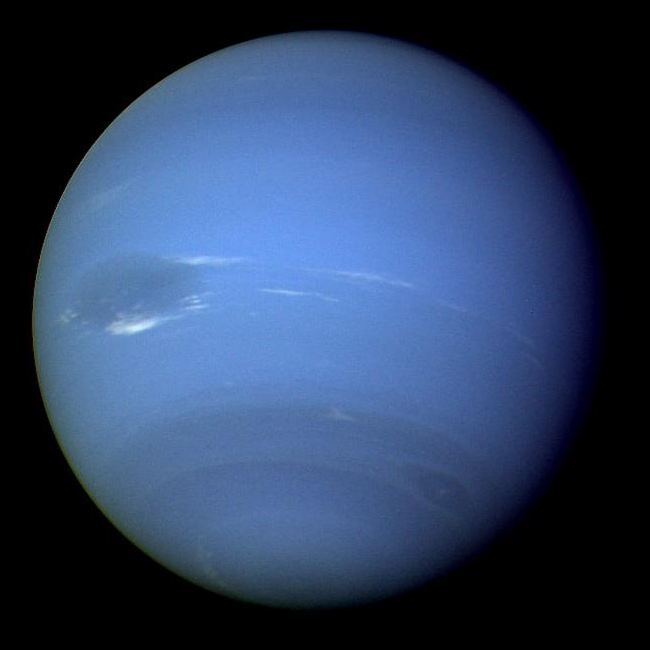 |
| Neptune from the Voyager 2 flyby (1989). |
The first hidden matter search came about with the discovery of Uranus by Sir William Herschel in 1781. With Newton's theory in hand, astronomers were able to calculate the orbit of the newly discovered planet, but by the early 19th century it had become clear that discrepancies existed between the predicted trajectory of Uranus and that which had been meticulously observed. These scientists were presented with a dilemma not unlike the one that their counterparts would face a century later: either Sir Isaac had gotten things wrong with his theory of gravity or a very significant mass had gone missing. Perhaps it took the form of a yet undetected outlying planet which was perturbing the motion of Uranus in its path around the Sun?
As disagreement between theoretical calculations and observational evidence became more and more convincing, a desperate race ensued. The hidden culprit, the planet Neptune, was revealed by Urbain LeVerrier in 1846.
 |
| First neutrino detection in a bubble chamber (1970). |
In a second example of a missing mass mystery, by 1930 the radioactive decay of atomic nuclei into constituents components had been long-observed and carefully measured, yet, as a result, a vexing question arose. When the energies of all the particles emerging from the site of such a decay were added up there was an unexpected energy shortfall. Either a new kind of particle had fled the scene undetected, carrying with it just the right amount of energy (and, according to Einstein, mass) or the long-cherished principle of conservation of energy - far more fundamental for physics than even Newton's universal gravitation - would have to be abandoned.
This fugitive particle, dubbed the neutrino by Enrico Fermi in 1934, eluded capture for more than two decades; science did not breathe a sigh of relief until Clyde Cowan and Frederick Reines detected it directly in 1956.
 |
| Schematic of Earth moving through the hypothetical aether. |
As a final example of the search for a missing substance - and an illustration that presuppositions demand verification - consider the state of the physics of electromagnetic radiation - i.e. light - in the late 19th century. About the time of the American Civil War James Clerk Maxwell, in what has become to be regarded as the first unified field theory of physics, demonstrated mathematically that light traveled as a wave, not unlike the way waves spread across the surface of a body of a water. In much the same way that other wave phenomena required a supporting medium - for example, some gas or mixture of gases for sound - it was presupposed that a medium was necessary for the propagation of light, something that pervaded every nook and cranny of space. Confident in this hypothesis, physicists even gave the conjectured substance a name; it was called the luminiferous (light-bearing) aether.
An ingenious experiment to detect the existence of this mysterious stuff was undertaken by Albert Michelson and Edward Morley in 1887. It failed utterly, but with that failure was planted the seed of Einstein's theory of special relativity which would blossom less than 20 years later.

It is important to point out that D'Souza's attempt to exploit the dark matter hypothesis as evidence of the comparability of scientific and religious reasoning about the world is just the latest round in the assault on science by those who, like him, feel that a purely materialist view of nature is incompatible with their deeply held religious beliefs. In the late 1980s they took aim at the theory of evolution with their Intelligent Design hypothesis and were, in short order, discredited. Probing for vulnerabilities elsewhere they have recently turned their sights on astrophysics and neuroscience, hoping for more favorable battlefields.
But, as Ken Miller, professor of biology at Brown University and a practicing Roman Catholic, noted in his essay, The Flagellum Unspun, which convincingly refutes claims of "irreducible complexity", the cornerstone of Intelligent Design theory,
... the struggles of the intelligent design movement are best understood as clamorous and disappointing double failures – rejected by science because they do not fit the facts, and having failed religion because they think too little of God.Sadly, Dinesh D'Souza seems compelled to repeat this same mistake, looking for confirmation of his belief in God in the wrong places, misrepresenting the enterprise of science and futilely struggling to insert the Deity in the forever-narrowing gaps in our understanding of the natural world.

Dinesh D'Souza, in the Dark about Dark Matter and about Science by Marc Merlin is licensed under a Creative Commons Attribution-NonCommercial-NoDerivs 3.0 Unported License.
Based on a work at thoughtsarise.blogspot.com.


